Understanding remote coaching for parents of autism
Remote coaching for parents of autism gives you structured support, guidance, and training from qualified professionals without requiring you to travel to a clinic. Instead, you connect through secure video sessions, phone calls, and online learning platforms.
In many modern autism programs, you are no longer just an observer in your child’s therapy. You are coached step by step to become a key partner in intervention, using strategies during daily routines like mealtimes, play, and bath time. Studies show that when remote support is added to caregiver‑mediated interventions, parents report lower stress, greater confidence, and more enthusiasm for training, with potential benefits for children’s development as well [1].
Remote services sit within a broader ecosystem that can include virtual autism therapy services, online parent training autism, telehealth therapy for autism spectrum, and home-based virtual autism support. Understanding how these options work can help you match support to your family’s needs and schedule.
Why remote parent coaching matters
Remote coaching is not a lighter or “less serious” version of support. For many families, it is the most realistic way to access consistent, high quality guidance.
You may live far from specialists, juggle multiple jobs, care for other children, or simply find it difficult to bring your child into a clinic several times per week. Remote parent training has been shown to improve parent adherence to intervention strategies and reduce psychological distress, while supporting gains in children’s social communication and behavior [1].
A 2017 review of remotely delivered parent mediated interventions found that these programs can improve parent knowledge, increase how accurately parents use strategies, and support better social behavior and communication in children, particularly for families outside urban areas [2]. When therapist contact is added to self guided online materials, parents and children tend to make even larger gains compared to self study alone [2].
Put simply, remote coaching matters because it brings expert support into your everyday life, in a way that is practical and sustainable.
How remote coaching for autism works
Remote coaching follows a structured, collaborative process rather than a one‑time consultation. You and your child’s provider typically move through several stages.
Initial assessment and goal setting
You usually begin with an intake or assessment session over video. During this time you might:
- Share your child’s history, evaluation reports, and current concerns
- Describe daily routines, strengths, and challenges at home and school
- Record or demonstrate short real‑life interactions, such as play or meal times
Some programs also conduct a virtual functional behavior assessment to understand the “why” behind challenging behaviors. Together you and the clinician define specific, realistic goals such as:
- Increasing your child’s ability to request help
- Reducing daily meltdowns around transitions
- Expanding play skills or social engagement with siblings
These goals guide your individualized telehealth autism care plan.
Teaching strategies through video and online modules
Next, your provider teaches you practical strategies you can use with your child. This may include:
- Live video demonstrations with your child, where the therapist models what to do
- Screen sharing or video examples of similar children and situations
- Short online modules, handouts, or quizzes to build your understanding
Evidence based e‑coaching programs for parents often use structured modules that cover social communication, engagement, autonomy, sleep, eating behavior, and screen time management, along with regular video debriefings with a therapist [3].
Live coaching while you interact with your child
A core feature of effective remote coaching is “live” guidance while you are with your child. The therapist might:
- Observe you play with your child through secure video
- Offer real time suggestions through a headset or by pausing and giving feedback
- Help you adjust how you give prompts, use reinforcement, or respond to behavior
Telehealth ABA services, for example, use this model to provide telehealth aba therapy autism that centers you as the main change agent at home. Programs such as OASIS and ATHENA have found that telehealth parent training can lead to large gains in parent skills and knowledge, comparable to in‑person formats [4].
Ongoing feedback, problem solving, and adjustment
Over time, sessions shift from teaching basics to troubleshooting and refining strategies. You and your coach will routinely:
- Review what worked well and what felt difficult
- Adjust goals as your child progresses
- Plan how to generalize skills to school, community settings, or new routines
Many effective programs include formal feedback tools or progress measures so that you can see change in both your child’s skills and your own confidence [1].
Types of remote autism support you can use
Remote coaching for parents of autism often works alongside other telehealth and virtual services. Depending on your child’s profile, you may combine several options.
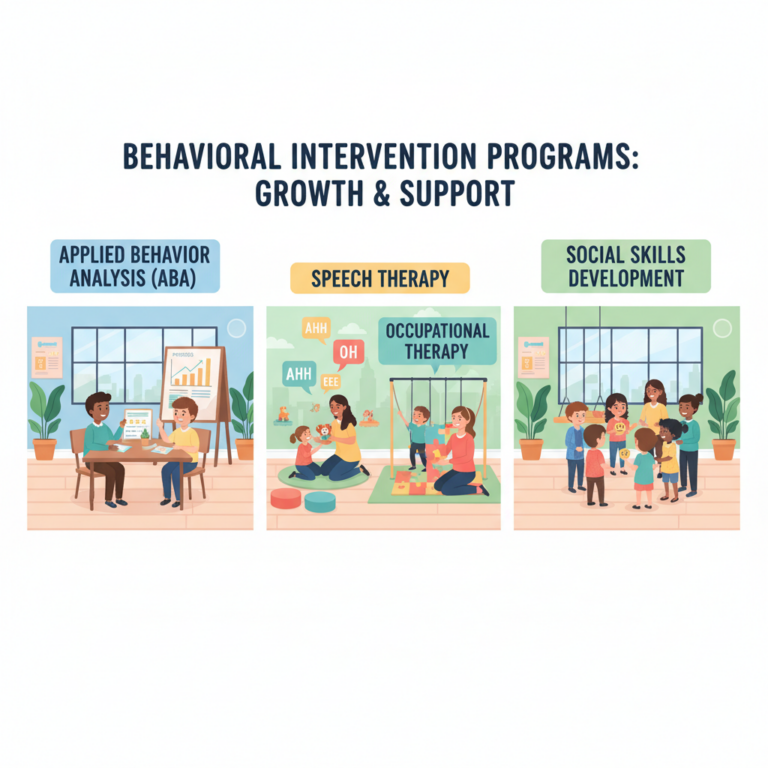
Telehealth ABA and behavioral support
If your child is receiving applied behavior analysis, telehealth can be integrated in different ways:
- Parent training as part of telehealth aba therapy autism
- Home based remote behavioral intervention autism focused on daily routines
- Remote oversight and virtual aba supervision services that support your in‑home team
Telehealth ABA parent training has been associated with better generalization of skills to the home environment, improved management of challenging behavior, and fewer missed sessions because you do not need to travel [4].
Speech and language teletherapy
Communication challenges are common in autism, and remote services can play a major role in addressing them. Options may include:
- Direct teletherapy for speech in autism for your child
- Coaching sessions focused on how you can support communication through everyday interactions
- Joint sessions with you, your child, and the speech language pathologist to practice routines together
Recent trials show that telehealth parent training can improve children’s social communication skills and parental adherence to strategies, which is especially valuable when speech goals are integrated into your daily life [1].
Remote social skills and counseling support
Your child may also benefit from social or emotional supports that can be delivered virtually, such as:
- Group or individual remote social skills therapy
- Virtual autism counseling services for emotional regulation and coping
- Virtual family counseling autism to address communication patterns and stress within the family
Parent coaching often runs alongside these services so you can reinforce emotional and social strategies at home.
Comprehensive virtual autism programs
Some providers offer integrated online autism intervention programs that combine:
- Online autism therapy for children
- Structured online parent training autism
- Access to a telehealth autism center or broader network of specialists
Family centered models, such as the Early Start Denver Model delivered via telehealth, specifically position you as an equal partner in setting learning goals and choosing strategies, rather than relying solely on provider driven decision making [5].
What makes remote parent coaching effective
Not all remote coaching programs are the same. Research highlights several components that tend to support better outcomes for both you and your child.
Use of accessible, user friendly technology
Effective programs use reliable video conferencing and mobile tools that are easy to navigate, even if you are not tech savvy. This may include:
- Secure video platforms that protect privacy and meet health information standards
- Mobile apps or portals where you can watch short videos, log questions, or track goals
- Options for asynchronous support, such as messaging or recorded feedback
Ensuring that you have stable internet and appropriate devices is a key implementation consideration in current telehealth autism models [1].
Tailored support that fits your family
Remote coaching is most helpful when it is not “one size fits all.” Programs that individualize content and pace tend to be more effective. This includes:
- Respecting your cultural background, language, and family values
- Adapting strategies to your home layout, work schedule, and caregiving demands
- Setting goals that match your child’s abilities and your comfort level
In a large randomized trial, remote support courses that were integrated with standard caregiver mediated interventions improved parental stress and sense of competence, partly because they were tailored to families’ circumstances [1].
Ongoing collaboration and feedback loops
You should expect a true partnership, not just instructions. Strong programs provide:
- Regular opportunities for you to ask questions and express concerns
- Clear summaries after sessions so you know what to practice
- Periodic reviews of child progress and parent wellbeing, and adjustments to the plan
The Lausanne e‑coaching trial, for example, combines structured online modules with monthly 90 minute videoconference debriefings, and evaluates changes not only in child development but also in parent child interaction quality and parental wellbeing [3].
When parent coaching is collaborative and validating, many caregivers report reduced guilt, burnout, and self doubt, as well as stronger emotional connection with their child [6].
Integration with broader telehealth services
Remote coaching is often most powerful when it is embedded inside a coordinated system of support that may include:
- Telehealth autism support programs
- A central telehealth autism center or telehealth services autism center
- Linked remote autism developmental support across speech, behavior, and social domains
This integrated approach helps you avoid conflicting advice and ensures that all providers are working toward shared goals.
Benefits and challenges for your family
Understanding potential benefits and challenges can help you decide whether remote coaching for parents of autism is a good fit right now.
Key benefits of remote coaching
Many families experience advantages in several areas:
-
Accessibility
You can reach specialists in ABA, speech, psychology, and developmental pediatrics without long travel, which is especially important if you live in a rural or underserved area [1]. -
Flexibility and reduced disruption
Sessions can be scheduled around work, school, and caregiving demands. Telehealth programs have documented thousands of miles of travel saved for families, with corresponding improvements in attendance and participation [4]. -
Stronger parent role and skill building
Telehealth parent training programs have shown average gains of over 80 percent in parent skill use and over 35 percent in knowledge in some models, with effectiveness similar to in person training [4]. -
Emotional support for you
Parent coaching can offer a validating space where you can process emotions, reduce stress, and feel less alone, which in turn supports the whole family system [6].
Common challenges and how to handle them
There are also challenges to plan for:
-
Technology issues
Unstable internet, older devices, or difficulty using portals can interrupt sessions. Asking your provider for a tech “practice run” and written instructions can reduce frustration. -
Engagement and focus
It can be hard for your child, or for you, to stay fully engaged on screen. Many programs now blend shorter, focused sessions with between‑session practice to help with this. -
Measuring outcomes
Some studies highlight that remote interventions still need more standardized ways to measure progress, which can affect how results are interpreted [2]. Asking your team what specific outcomes they track can increase transparency. -
Balancing self guided and supported learning
Research suggests that programs combining self guided materials with therapist support tend to outperform purely self guided options [2]. If you choose a mostly self paced course, consider adding at least periodic live check ins.
You do not need a perfect setup to start. Many families work through these challenges gradually with help from their providers.
Choosing a remote coaching program
When you evaluate remote coaching options, it helps to use clear decision points rather than relying only on marketing language.
Questions to ask potential providers
You might ask:
- What specific parent coaching model do you use, and is it evidence informed?
- How often will we meet, and for how long is the program designed to run?
- How will you individualize strategies for our family’s culture, language, and routines?
- How do you coordinate with our existing in person or online services, such as virtual autism therapy services or online autism therapy for children?
- What outcomes do you track for both parent and child, and how will we review progress?
- What technology do we need, and how do you support us if issues come up?
Their answers will help you gauge alignment with your values, your schedule, and your child’s needs.
Matching services to your priorities
Different families prioritize different outcomes. For example:
- If you want to build foundational parenting strategies and emotional resilience, a program focused on parent coaching and virtual family counseling autism may be a strong fit.
- If your child’s main needs are communication and speech, look for programs that integrate teletherapy for speech in autism with parent training.
- If behavior and daily living skills are central concerns, you might prioritize remote behavioral intervention autism and structured ABA based coaching.
Many telehealth autism support programs can combine these components into a cohesive telehealth autism care plan so that you are not managing them separately.
Getting started with remote coaching
If you are considering remote coaching for parents of autism, you can move forward in manageable steps.
First, clarify your top concerns. You might list three daily situations that feel most stressful, such as bedtime, transitions to school, or public outings. Bring these real examples into your first consultation.
Next, explore providers that offer integrated telehealth services, such as a telehealth autism center that coordinates ABA, speech, and parent support. Ask specifically about home-based virtual autism support and remote parent training options.
Once you enroll, give yourself time to grow into this role. Remote coaching is not about being a “perfect therapist” for your child. It is about gradually building tools, confidence, and insight so that you can respond more effectively in everyday moments.
Finally, remember that your wellbeing matters. Choosing programs that support you emotionally, not just instruct you, can make a meaningful difference for your entire family. As current research suggests, when your stress decreases and your sense of competence increases, your child is more likely to benefit from the overall treatment approach [1].