What an autism functional behavior assessment is
An autism functional behavior assessment (often called an FBA) is a structured process that helps you and your care team understand why your child is engaging in challenging behaviors, not just what they are doing.
Instead of viewing behavior as random or “bad,” an FBA looks at the patterns around it. A Board Certified Behavior Analyst (BCBA) or similarly trained professional collects information about:
- What happens before the behavior
- What the behavior looks like
- What happens after the behavior
This is often referred to as the ABCs of behavior: Antecedent, Behavior, Consequence. By examining these patterns across home, school, and community settings, the clinician identifies the function or purpose of the behavior and then designs effective, individualized interventions around it [1].
Research with autistic children and teens consistently shows that interventions built on a solid FBA are more successful at reducing challenging behavior and increasing positive skills than interventions that do not use this process [2].
An FBA is not about blame. It is about understanding your child’s needs and giving them more effective, respectful ways to communicate and cope.
When an autism functional behavior assessment is recommended
You might be encouraged to pursue an FBA for your child in several situations. Common reasons include:
- Ongoing behaviors that interfere with learning, communication, or daily routines
- Safety concerns such as self-injury, aggression, or elopement or running away
- Intense tantrums or meltdowns that feel unpredictable or difficult to prevent
- School suspensions or repeated calls home related to behavior
- A new autism diagnosis with significant behavior or regulation challenges
For children with autism, problem behaviors such as self-injury, aggression, and elopement are unfortunately common. For example, self-injurious behavior can occur in roughly one third to over two thirds of individuals with autism spectrum disorder, aggression in 7 to 56 percent, and elopement in up to 49 percent [3]. These numbers highlight how important early and thoughtful assessment is.
In schools, federal law also recognizes the role of FBAs. Under the Individuals with Disabilities Education Act (IDEA), schools are required to conduct an FBA when a student with a disability is removed from their educational placement for more than 10 days due to behavior. This helps ensure that your child’s behavior plan and special education supports are individualized and appropriate [4].
If you are seeing patterns that worry you or your child’s team is struggling to make progress, an FBA can be a helpful next step.
Who conducts the assessment and who is involved
A high quality autism functional behavior assessment is a team effort, but it is always led and interpreted by a trained professional.
Qualified professionals
FBAs should be conducted or supervised by:
- Board Certified Behavior Analysts (BCBAs or BCBA-Ds)
- School psychologists
- Special education professionals with training in behavior analysis
These professionals are responsible for designing the assessment, analyzing the data, and developing the behavior intervention plan (BIP) that follows [5].
Your essential role as a caregiver
As a parent or caregiver, you are a central member of the team. You might:
- Share detailed history about your child’s development and current routines
- Describe what you see at home and in the community
- Complete questionnaires or rating scales
- Help collect data between sessions
- Provide feedback on what strategies feel realistic for your family
Teachers, therapists, and other caregivers are usually interviewed or asked to share data as well. This collaborative approach ensures that the assessment captures behavior across settings and perspectives [6].
The four main behavior functions in autism
A key goal of an autism functional behavior assessment is to identify the function of your child’s behavior. In other words, what does your child gain or avoid by behaving this way?
Most challenging behaviors fall into one or more of these four main functions, often summarized as SEAT [7]:
-
Sensory: The behavior provides sensory input or helps regulate uncomfortable sensations.
Examples include hand flapping, rocking, or head banging that occurs even when no one else is around. -
Escape or Avoidance: The behavior helps the child escape or avoid something that feels hard, overwhelming, or unpleasant.
For instance, a child may hit or throw items when a difficult task is presented or when asked to transition away from a favorite activity. -
Attention: The behavior reliably gets a response from adults or peers, even if that response is negative.
Yelling, interrupting, or silly behavior during quiet time might fall into this category if it consistently leads to attention. -
Tangible: The behavior helps the child get access to a desired item or activity, such as a toy, snack, or screen.
A child may engage in a tantrum because in the past that behavior led to getting what they wanted.
Understanding function is powerful. It shifts the question from “How do we stop this?” to “How do we teach a safer, more effective way for my child to get this same need met?”
The step by step FBA process
Although every child and setting is unique, autism functional behavior assessments usually follow a structured sequence of steps [5].
1. Define the target behaviors
The team begins by deciding which behaviors to focus on and describes each in clear, observable terms. For example:
- Instead of “meltdowns,” the behavior might be written as “drops to the floor, cries loudly, and hits head with hands.”
- Instead of “noncompliance,” the behavior might be “does not begin the requested task within 30 seconds.”
This level of clarity helps everyone recognize when the behavior is happening so data are accurate.
2. Collect background information and indirect data
Your clinician will gather information through:
- Interviews with you, other caregivers, teachers, and therapists
- Rating scales or checklists about behavior, communication, and sensory needs
- Review of past evaluation reports or incident records
Tools such as the Autism Treatment Evaluation Checklist (ATEC) can help track patterns and changes in behavior over time [8].
3. Observe behavior directly in natural settings
Direct observation is a critical part of an FBA. The assessor watches your child in the environments where behavior typically occurs, such as:
- Home routines like meals, homework time, or bedtime
- Classroom or therapy sessions
- Community settings like playgrounds or stores
During observation, the assessor records the ABCs for each incident:
- Antecedent: What was happening before the behavior
- Behavior: Exactly what your child did
- Consequence: What happened immediately after
Descriptive assessments like these are common and help reveal patterns that might not be obvious in day to day life [3].
4. Analyze data and form a hypothesis
Once enough data have been collected, the assessor looks for consistent patterns. For example:
- Does the behavior mostly happen when a specific task is given?
- Is it more likely when your child is tired, hungry, or in a noisy space?
- What typically changes right after the behavior occurs?
From this analysis, the clinician develops one or more hypotheses about the function of the behavior. For instance, they may conclude that your child’s hitting is most likely maintained by escape from hard work, attention from adults, or a combination.
In some cases, especially for severe or complex behaviors, a more formal functional analysis may be used, where different situations are carefully arranged to confirm which events trigger and maintain the behavior [3].
5. Rule out medical and sensory factors
Throughout the assessment, it is important to consider medical and physiological contributors such as pain, sleep issues, seizures, or gastrointestinal discomfort. Functional behavior assessment best practices emphasize ruling out or addressing medical causes before relying solely on behavioral strategies [9].
You may be encouraged to talk with your child’s pediatrician, neurologist, or other specialists as part of this process.
6. Develop a Behavior Intervention Plan (BIP)
The final step is to use everything learned to write a Behavior Intervention Plan. A BIP typically includes:
- A clear summary of the behavior and its function
- Environmental changes to reduce triggers
- Skills to be taught, such as communication or coping strategies
- How adults should respond when behavior occurs
- Safety steps for more severe behaviors
- How progress will be tracked and reviewed
FBAs directly guide these plans so that strategies address the true reasons for behavior, not just the surface level actions [4].
How FBAs guide ABA and behavioral interventions
An autism functional behavior assessment is a cornerstone of effective applied behavior analysis (ABA) and other autism behavioral intervention services. Instead of using a one size fits all approach, your child’s team can target the right skills at the right time.
Function based behavior strategies
When function is clear, your child’s ABA team at an applied behavior analysis center or through aba therapy for autism can create interventions such as:
- Teaching your child to ask for a break, instead of engaging in escape behavior
- Providing structured attention on a regular schedule, rather than only in response to challenging behavior
- Offering sensory activities that meet your child’s needs in safe ways
- Using clear schedules and transition supports to reduce anxiety and uncertainty
A common approach that grows directly from FBAs is Functional Communication Training (FCT). Research shows that when children learn effective, respectful ways to communicate what they need, dangerous or disruptive behaviors often decrease significantly [3].
Early intervention and prevention
For younger children, especially those in early intervention behavioral therapy, there is strong value in using functional assessment principles even before severe behavior emerges.
Researchers describe four “Big Four” skill areas that help prevent later problem behaviors in children with developmental disabilities, including autism [3]:
- Communicating wants and needs in effective and respectful ways
- Gaining social attention through pleasant, safe behaviors
- Joyful participation in both solitary and social activities
- Safe and effective coping with frustration and adversity
When your child’s autism behavior therapy services prioritize these areas, you are building a strong foundation for long term success.
Telehealth and remote support
FBAs and related training can also be delivered using telehealth. Studies have shown that when parents and staff receive remote coaching on conducting FBAs and implementing function based strategies, most are able to learn the skills and see meaningful reductions in challenging behavior at home [10].
This can improve access if in person services are limited in your area.
An FBA does not label your child. It clarifies their needs so their care plan can be more compassionate, targeted, and effective.
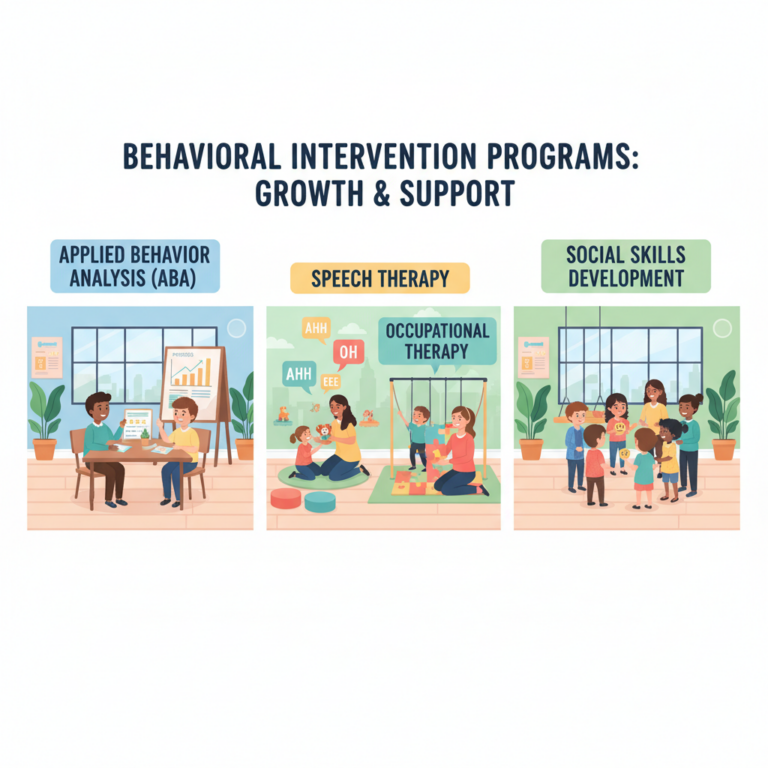
Integrating speech, OT, and social skills with an FBA
Although functional behavior assessments are often led by ABA professionals, the information gathered can and should guide your child’s broader therapy support for autism. Many children benefit from an integrated plan that includes behavior, speech, occupational, and social skills services.
Speech and language therapy
Challenging behaviors frequently occur when a child struggles to express themselves or understand others. Your child’s FBA can highlight moments where communication breaks down, which in turn can inform their work at a speech therapy autism center or in autism speech & language therapy.
Speech therapists may:
- Teach words, signs, or communication device use that match the function of the behavior
- Help your child understand directions, routines, or social cues that currently trigger frustration
- Coordinate with ABA therapists to reinforce the same communication strategies across settings
When your child has reliable ways to say “help,” “break,” or “all done,” you often see powerful changes in behavior.
Occupational therapy and sensory supports
Sensory needs are a core part of many autistic children’s lives and can strongly influence behavior. An FBA might uncover that your child’s outbursts or avoidance show up in noisy, bright, or crowded environments, or after long periods of sitting.
Occupational therapists who specialize in occupational therapy autism or ot for children with autism can:
- Develop sensory strategies that help your child stay regulated
- Suggest environmental changes to reduce overwhelming input
- Build motor and daily living skills that increase your child’s independence
When OT plans are aligned with FBA findings, your child’s day can be structured in a way that feels safer and more manageable.
Social skills and peer relationships
An FBA may highlight that your child behaves differently when peers are present, either to gain attention or to avoid social situations that feel confusing.
Programs that focus on social skills therapy autism or autism social skills groups use these insights to:
- Teach your child how to join games, ask to play, or say “no” appropriately
- Practice turn taking, sharing, and problem solving in a predictable way
- Reduce anxiety around social situations by breaking skills into manageable steps
When behavior plans and social skills programs are coordinated, your child is supported both in managing behavior and in building meaningful relationships.
Coordinated, integrated therapy services
Many families find it helpful to work with an autism support therapy clinic that offers integrated therapy autism services. In these settings, ABA providers, speech therapists, occupational therapists, and social skills specialists can share FBA information and plan together.
This kind of teamwork supports:
- Consistent strategies across home, school, and therapy
- Shared goals in your child’s autism therapy programs
- A single, coordinated autism therapy plan development process
- Clear guidance around autism therapy insurance accepted and coverage for combined services
You do not have to coordinate everything alone. A well organized team can use the FBA as a roadmap for all areas of development.
Your role in making the FBA successful
Your insight and involvement make a significant difference in how useful an autism functional behavior assessment will be for your child.
Share your observations openly
You see your child across many moments in the day, including times when professionals are not present. Try to:
- Take brief notes on behavior patterns before the assessment begins
- Share what has and has not worked in the past
- Describe any recent changes in sleep, health, routines, or stress
Your detailed input can help the team consider important medical or environmental factors that might otherwise be missed.
Participate in data collection and plan review
FBAs and the behavior plans that follow are not one time events. Ongoing data helps your team know whether strategies are working and where adjustments are needed [5].
You can support this process by:
- Tracking behavior and new skills with simple charts or apps recommended by your team
- Attending plan review meetings and asking questions
- Sharing honest feedback about what feels realistic at home
If your providers offer parent training in ABA, this can be an excellent way to learn how to apply FBA concepts in your daily routines.
Advocate for comprehensive supports
If your child has had an autism diagnosis, a specialist will typically coordinate a team to perform assessments that may include FBAs alongside other developmental evaluations. These assessments guide recommendations for behavioral, social, emotional, and cognitive supports [8].
You can advocate by:
- Asking whether behavior interventions are based on an FBA
- Requesting that FBA findings inform your child’s school IEP or 504 plan
- Exploring behavioral intervention programs that use function based approaches
- Ensuring that behavior information is shared across your child’s full team, including medical providers and therapists
With your participation, an FBA becomes not just a report, but a living tool that shapes how everyone supports your child.
Moving forward with confidence
An autism functional behavior assessment gives you and your child’s team a clear, compassionate understanding of why challenging behaviors are happening and what your child needs instead. It connects directly to:
- Targeted autism behavior therapy services
- Coordinated work with speech, occupational, and social skills providers
- Individualized autism therapy programs that reflect your child’s strengths and challenges
Most importantly, it offers a path from reacting in the moment to planning ahead with confidence and care.
If you are ready to explore function based support for your child, you can start by asking your current providers about an FBA or by reaching out to an autism support therapy clinic that offers integrated services and ABA based assessment. With the right information and a collaborative team, you and your child do not have to navigate these challenges alone.