When you begin exploring autism evaluation insurance accepted benefits, you want to ensure that diagnostic testing and core therapy services are covered by your health plan. Understanding your coverage options helps you make informed decisions, manage out-of-pocket costs, and secure the support your child needs. In this guide, you’ll learn how to assess plans, compare policy types, navigate pre-authorization, and connect with qualified providers for both evaluation and early intervention.
Assess coverage options
Before scheduling any assessments, review your existing policies to identify which services are covered and under what conditions.
Identify plan types
- Employer-sponsored group plans
- Individual or Marketplace policies
- Medicaid and the Children’s Health Insurance Program (CHIP)
- State-mandated autism coverage laws
Each plan type may offer different benefits for diagnostic and therapeutic services. You’ll want to verify whether your policy classifies autism testing and treatment as a covered benefit.
Understand policy benefits
Review your summary of benefits and coverage (SBC) to find sections on behavioral health, developmental evaluations, and therapy services. Key details to note:
- Covered services: diagnostic autism evaluation, autism screening services, autism behavioral assessment
- Cost-sharing: deductibles, copays, coinsurance rates
- Benefit limits: annual caps on evaluation or therapy hours
- Network restrictions: in-network versus out-of-network providers
If anything is unclear, contact your plan administrator or member services to confirm which aspects of an autism assessment and therapy are included.
Compare insurance plans
Evaluating multiple policy options can reveal significant differences in coverage, costs, and provider networks.
Private insurance coverage
Under the Affordable Care Act, many private health plans must cover medically necessary autism evaluations and therapies. Still, requirements vary:
- Age limits: some plans cover pediatric assessments more comprehensively than adult testing
- Pre-authorization: required for specialized testing or Applied Behavior Analysis (ABA) services
- Referral requirements: primary care or pediatrician referral needed before evaluation
Medicaid and CHIP
If your income qualifies, Medicaid and CHIP often provide robust coverage for autism evaluation and early intervention. Coverage can include:
- Diagnostic assessments by psychologists, speech-language pathologists, and other specialists
- Applied Behavior Analysis (ABA) therapy and related services
- Family training and support services
Eligibility and covered services vary by state, so check your state’s Medicaid website or contact your local Medicaid office to learn which autism services are included.
State-mandated coverage
Over 40 states require insurers to cover autism evaluations and at least some core interventions such as ABA therapy. Visit your state insurance department website to confirm specific mandates, benefit limits, and network requirements in your region.
Review cost considerations
Knowing typical price ranges and cost drivers helps you anticipate out-of-pocket expenses.
Typical evaluation costs
| Evaluation type | Cost range | Notes |
|---|---|---|
| Basic developmental screening | \$250–\$500 | Initial check for autism risk factors |
| Comprehensive diagnostic evaluation | \$1,200–\$3,000 | In-depth assessment by multidisciplinary team [1] |
| Specialized diagnostic tools | \$800–\$5,000 | Neuropsychological testing, standardized instruments |
| Adult autism assessment program | \$485 | Flat-fee program for adult screening and evaluation |
| Standard adult testing and evaluation | \$695 | Typical cost when billed without insurance |
| Intensive adult evaluation | \$1,500–\$2,250 | Full battery of clinical interviews and assessments |
Factors affecting pricing
- Provider qualifications: neuropsychologists often charge more than general psychologists
- Geographic location: urban centers typically have higher fees than rural clinics
- Assessment depth: multi-hour evaluations with multiple specialists increase cost
- Clinic setting: university-based or community clinics may offer sliding scales
Insurance coverage limits
Many insurers impose limits on the number of covered sessions or total annual benefits:
- Annual dollar caps for evaluations or therapy
- Session limits per week or month for ABA services
- Lifetime maximums for certain interventions
Review your policy’s coverage limits to plan for any potential costs beyond the benefits.
Navigate pre-authorization requirements
Obtaining approval in advance prevents claim denials and unexpected bills.
Obtaining referrals
If your plan requires a referral, ask your pediatrician or primary care provider to submit one for:
- Diagnostic autism evaluation
- Autism developmental evaluation
- ABA therapy or other behavioral interventions
Documenting medical necessity
Insurance companies will often ask for:
- Detailed reports of developmental concerns
- Standardized test results or screening summaries
- Clinical notes supporting the need for specialized assessments
Providing thorough documentation upfront accelerates authorization.
Dealing with denials
If your claim is denied:
- Review the denial letter for specific reason codes
- Gather supporting documents and clinical notes
- File an appeal with your insurer, following their appeal process
- Keep detailed records of all communications, including names, dates, and summaries of conversations [2]
Explore assistance programs
When insurance gaps remain, look to external resources for financial support and advocacy.
State programs overview
- Medicaid waivers (Home and Community-Based Services)
- Supplemental Security Income (SSI) for qualified families
- Temporary Assistance for Needy Families (TANF) programs
Many states offer waivers specifically for autism screening, diagnosis, and therapy. Check with your state’s health department for eligibility and application details.
Nonprofit and community support
Organizations such as Autism Speaks provide:
- Online tools to verify your health benefit plan
- Assistance with benefit implementation and appeals [3]
- Grants or vouchers for families in financial need
Local autism support groups and community clinics may also offer low-cost or sliding-scale evaluation services.
Schedule diagnostic evaluations
Identifying autism spectrum disorder early leads to better long-term outcomes. Here’s how to find and arrange an assessment.
Choosing evaluation type
- Initial screening: quick tools to flag risk factors, refer to autism screening services
- Full diagnostic evaluation: multidisciplinary assessment at an autism assessment clinic or autism testing center
- Behavioral assessment: specialized observation and interaction analysis [4]
Finding local clinics
- Search for autism diagnostic services in your area
- Look for clinics accredited in developmental and neuropsychological assessment
- Contact university-affiliated programs for potentially reduced fees
When you reach out, confirm:
- Accepted insurance plans
- Pre-authorization requirements
- Wait times and evaluation duration
Plan early intervention
Early support lays the foundation for skill development and daily functioning.
Core therapy services
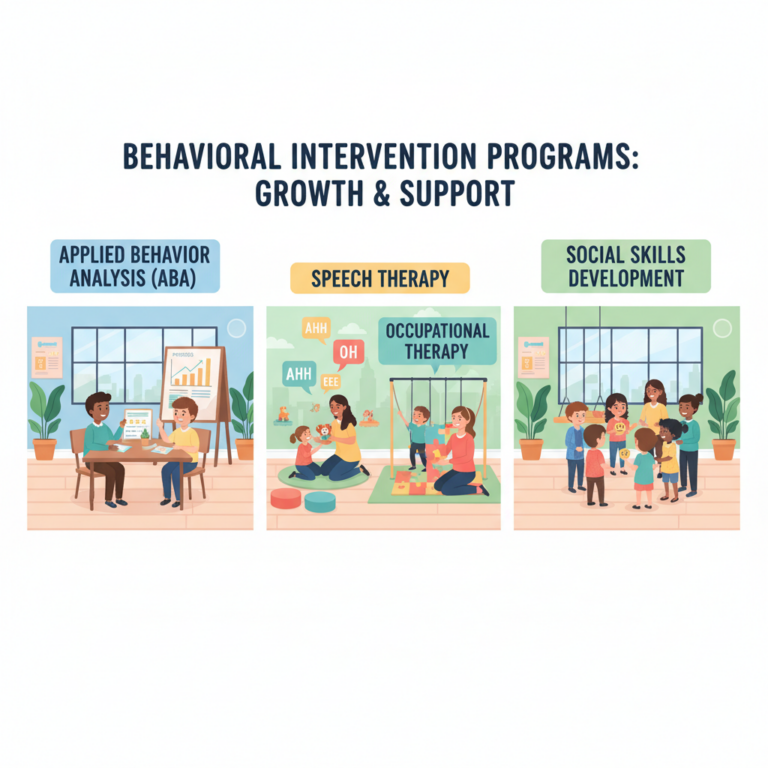
Key interventions include:
- Applied Behavior Analysis (ABA)
- Speech-language therapy
- Occupational therapy
- Social skills training
Verify coverage for ongoing therapy by checking limits on sessions and whether services must be delivered at an autism therapy center or can occur in your home or community.
Linking therapy coverage to diagnosis often requires:
- Formal diagnosis report from a licensed provider
- Prescription or therapy referral
- Pre-authorization for each therapy type
Linking therapy coverage
- ABA services: at least 200 million people now have coverage thanks to Autism Speaks advocacy [3]
- Speech and occupational therapies: often covered under rehabilitative services
- Early intervention programs: state-funded services for children under age three
Discuss with your insurance representative how therapy services integrate with evaluation benefits.
Select qualified providers
Choosing the right professionals ensures accurate diagnosis and effective treatment planning.
Clinic accreditation
Seek clinics with:
- Joint Commission accreditation
- Certification from the Behavior Analyst Certification Board (BACB) for ABA
- Membership in the American Psychological Association (APA)
Specialist credentials
For a thorough clinical autism assessment, look for:
- Licensed psychologists or neuropsychologists
- Speech-language pathologists certified by ASHA
- Board-certified behavior analysts (BCBA)
- Pediatricians with expertise in developmental disorders [5]
For toddlers, ensure providers have experience in autism diagnosis for toddlers and early childhood assessment.
Take next steps
With coverage insights and provider options in hand, you can move forward confidently.
Verify your coverage
- Call your insurer’s member services
- Confirm covered evaluation types and therapy services
- Note your policy’s referral, pre-authorization, and billing procedures
Prepare for evaluations
- Gather past medical and developmental records
- Complete any insurer or clinic intake forms
- List your child’s behaviors, strengths, and concerns
Access support resources
- Use online tools from Autism Speaks
- Reach out to local parent support groups
- Explore financial assistance through state-based programs
Overall, understanding autism evaluation insurance accepted benefits empowers you to secure the diagnostic and therapeutic services your child deserves. By assessing your options, planning for costs, and partnering with qualified providers, you’ll set the stage for a positive assessment experience and timely early intervention.
References
- (Grateful Care ABA)
- (Double Care ABA)
- (Autism Speaks)
- (autism behavioral assessment)
- (pediatric autism diagnosis service)